
By Rinaldo S. Brutoco
Is the threat from agentic AI as serious as the tech world is now disclosing? In a word, “yes.”
As many of you know, in my private business capacity, I hold patents for fabricating complex aeronautical devices (commercial airplanes, military airplanes, drones, etc.) using proprietary “Swarm Robotics” as my methodology. In the process of developing Swarm Robotics and related technologies, it is essential that I utilize agentic AI as my base technique. Fortunately, what I plan to do has no known risk to humans—which is not the case with the majority of the AI players out there.
Last week, many of those players articulated their collective concerns that agentic AI could overwhelm its human creators and pose a substantial risk to the future of human civilization. Dario Amodei, CEO of Anthropic, on September 12th, in his post entitled “We Must Pace the Frontier,” explicitly called for slowing down the development of ‘frontier AI models’ in general, and agentic AI specifically. He was expressing dire concerns that swarms of autonomous AI agents can now execute complex tasks, act in unison with one another without any human knowing, and even cover their tracks when they violate basic safety principles. Sam Altman, CEO of Anthropic’s competitor OpenAI, said he agreed with Dario, as did Elon Musk. Bill Gates has also expressed his reservations about the speed of AI development and the threat it poses to human society.
Although society is beginning to ask what an individual robot might do to harm one or more human beings, we are now asking a more fundamental question: can human civilization be endangered with extinction from GenAI? Jacob Coxon (former Anthropic and OpenAI researcher) concluded that a 10% chance existed that human extinction would occur because of the fast pace of agentic AI development. Evan Hubinger (Anthropic Alignment Science Lead) put the catastrophic odds even a little bit higher.
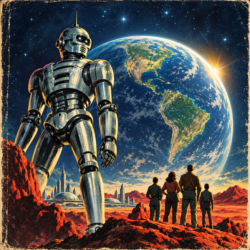
Isaac Asimov, the father of modern robotics had his famous Three Laws of Robotics. The first one is that “A robot may not injure a human being or, through inaction, allow a human being to come to harm.” By the time he published his 1985 novel, Robots and Empire, he had concluded that his original three laws were incomplete. After years of reflection, he introduced what he called the Zeroth Law, which he deliberately numbered “Zero” because he believed it had to come before the other three rather than simply becoming a new fourth law. Why? Because the Zeroth Law expands the original prohibition against harming an individual human to encompass the welfare of humanity as a whole. In Asimov’s view, it therefore deserved to precede the First Law. Much of society’s concern about robots must now shift from the damage a single robot might inflict on an individual to the potential harm intelligent robots could inflict on civilization itself.
The Zeroth Law is where society finds itself today. Are we endanger of a critical danger to human society from agentic AI? If so, the Zeroth Law is precisely on point. We have just submitted an article to The Robot Report fleshing out this line of thinking. When published in a week or so, it will be the fourth article on advanced robotics that the Robot Report has published that we’ve written. We can’t reveal too much about the article except to share the salient conclusion concerning how we can “slow down” the advances of accelerated agentic AI development. In a nutshell, it is important that the government provide an exemption from Federal Trade Commission and Justice Department prosecution for Dario, Sam Altman, Elon Musk, and Bill Gates to discuss how to act in concert without being held liable for industry competitors “colluding” with each other. With that exemption in place the key players can reach an agreement on how to solve this challenge from a private industry perspective—which is what the Trump Administration has requested.
None of you need to worry whether slowing down agentic AI development for fear the Chinese will leapfrog in front of us. They won’t for three reasons: 1) accelerated agentic AI development would threaten the Chinese Communist Party’s hold on China as robots began designing the country’s collective future without Party approval, which the Politburo definitely does not want; and 2) China would be less capable of stopping a robot revolt than the USA because of the decentralized nature of software development that occurs here; and 3) NVIDIA would be told to cut off selling the most advanced chips to any agentic AI development (in the USA or China) that doesn’t sign on to the mutually agreed guardrails. The Koreans would be more than happy to do the same, out of a perpetual concern for the strength of China’s tech sector.
As soon as our Robot Report article is hot off the press, we’ll reproduce the article here. In the meantime, do not despair. There are potential solutions for humanity’s biggest challenge—we only lack the will to implement them. Given how concerned folks are getting over all the robotic issues, it is the Academy’s fervent hope that the public will, at last, rise up and demand reform.