
October 27, 2026
By Rick Wayman
At the World Business Academy, our guiding mandate is “taking responsibility for the whole.” While we typically direct that challenge toward businesses, true systemic change also requires governmental bodies to do their part by clearing the path when forward-thinking companies step up with solutions that serve the entire community.
In Goleta, California, the local government has just such an opportunity. The city is currently considering the proposed Greenbark Battery Energy Storage System, a vital project situated at a strategic interconnection point adjacent to the aging Ellwood gas peaker plant.
Localized battery storage and microgrids are indispensable to a comprehensive regional resilience strategy, particularly for vulnerable areas like the Goleta Load Pocket that are tied to fragile, wildfire-prone transmission corridors. As solar capacity expands and clean technology matures, approving distributed storage allows communities to finally transition away from polluting fossil-fuel infrastructure, capture midday solar power, and keep reliable energy close to home.
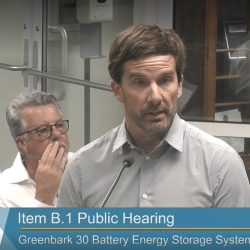
Below are the public comments I delivered to the Goleta Planning Commission on October 26, 2026, urging our commissioners to take responsibility for the whole and approve this critical project.
*****
Good evening, Chair and Commissioners. My name is Rick Wayman. I am Executive Director of the World Business Academy, a nonprofit organization headquartered in Santa Barbara. I am a resident of unincorporated Santa Barbara County, within the Goleta Load Pocket. I am speaking tonight in strong support of the Greenbark Battery Energy Storage System (BESS).
The Goleta Load Pocket is uniquely vulnerable, relying on fragile, long-distance transmission lines that run through extreme wildfire terrain. Due to this vulnerability, we need to do everything we can to build resilience. Greenbark is staged at the single best location in our entire region: it shares an interconnection point with the Ellwood Gas Peaker plant. That specific interconnection is already engineered to support the entire Goleta Load Pocket, which is a capability unmatched by any other viable BESS site in our community.
For years, the polluting Ellwood gas peaker plant has received lifetime extensions because of a deficiency of clean distributed energy resources capable of providing local resilience. Approving Greenbark is the concrete step we need to finally accelerate Ellwood’s retirement.
Furthermore, Greenbark unlocks the next phase of our local clean energy transition. You cannot expand local rooftop and community solar across the Goleta Load Pocket without having the storage capacity to absorb daytime peak generation. Greenbark provides the regional grid buffer needed to soak up midday solar and shift it into the evening hours when our community actually needs it, clearing the path for more local solar while keeping our power local, reliable, and clean.
This transition also delivers substantial, tangible economic value directly to our community. Greenbark is projected to generate 38 million dollars in total economic stimulation, including 33 million dollars in additional local wages. It will create nearly 500 job-years for our workforce between construction, operations, and maintenance.
Battery storage is already woven into our local fabric. We live safely alongside the 160 megawatt-hour Goleta Energy Storage facility, as well as operational solar microgrids in our schools, including at Dos Pueblos High School. Greenbark’s state-of-the-art designs meet today’s most stringent fire and safety codes.
Greenbark delivers the resilience the Goleta Load Pocket urgently needs, sets us up to phase out a dirty gas peaker plant, anchors our local clean energy future, and meets the highest safety benchmarks available today. I urge the Planning Commission to approve the Greenbark BESS proposal tonight. Thank you.